Friday, February 01, 2008

PERSONAL JOURNAL/MEDITATION AND REFLECTION: Hebrews 2:5-9

5 For He did not subject to angels the world to come, concerning which we are speaking.

6 But one has testified somewhere, saying, “

What is man, that You remember him? Or the son of man, that You are concerned about him?

7 “You have made him for a little while lower than the angels; You have crowned him with glory and honor,

And have appointed him over the works of Your hands;

8 You have put all things in subjection under his feet.”

For in subjecting all things to him, He left nothing that is not subject to him. But now we do not yet see all things subjected to him.

9 But we do see Him who was made for a little while lower than the angels, namely, Jesus, because of the suffering of death crowned with glory and honor, so that by the grace of God He might taste death for everyone.


The preacher begins this section of his sermon by returning the minds of his hears back to 1:14, “Are they not all ministering spirits”, after taking a break from his main theme to exhort believers to “pay much closer attention” to the message they have heard lest they “drift away from it.” He uses these verses to transition our attention from the exulted Son to the incarnated Jesus. God “did not subject to angels the world to come”, but He did to the Son who sits at His right hand. But before the exultation, “What is man, that You remember him? Or the son of man, that You are concerned about him? You have made him for a little while lower than the angels”. Hebrews 2:9 tells us that this one made lower than the angels for a “little while” refers to Jesus in His incarnation. It is in the incarnation that Jesus suffered “death crowned with glory and honor”. This therefore provides for the perfect transition from the glorified Son who is the heir of all things, creator of the world, worshipped by the angels, the eternal God who has been exulted above the cosmos for an eternal reign at the right had of God to the lowly Jesus who came to us as man proclaiming the gospel of the kingdom only to suffer death that “He might taste death for everyone.”

The difficulty of this passage comes from the seeming contradiction of Hebrews 1:13 and its use of Psalm of 110:1, “Sit at My right hand, until I make Your enemies a footstool for Your feet” and its future accomplishment and Hebrews 2:8 and its use of Psalm 8:6, “You have put all things in subjection under His feet” as an accomplished event in history. The preacher however takes these two texts and deals with the tension between the “now” and the “not yet”. Hebrews 2:8 is completely correct when it says that Christ now reigns over the cosmos as the one crowned with glory and honor. All things have been put under His subjection, but “we do not yet see all things subjected to Him” so that God is still at work making His “enemies a footstool” for His feet.

This is referred to as “the inaugurated rule of Christ”, where Christ is reigning, but the full experience of the kingdom will not be known till the final consummation when He restores all things. Until then the reality of His reign must be received by faith knowing that in the end we will see Him as He is. Calvin puts this beautifully in his commentary on Hebrews,

“As Christ carries on war continually with various enemies, it is doubtless evident that he has no quiet possession of his kingdom. He is not, however, under the necessity of waging war; but it happens through his will that his enemies are not to be subdued till the last day, in order that we may be tried and proved by fresh exercises.”

Thus, Christ has all under His subjection, but allows His enemies to battle against Him for His purposes.


This passage of Scripture gives further encouragement to the believers who might be struggling with their hope. God did not subject the world to angels. In the beginning He subjected it to man, as Psalm 8 shows, but because of the sin of Adam it was removed from man. It is only by the second Adam, the Son, who came incarnate and tasted death for all men, baring the sins of men, that subjection might be restored, but not to all men, only the One who was obedient. Thus Christ is our example of overcoming trials and afflictions and the evidence of our hope for us who follow. Though the Son’s realm was heaven from the beginning, He chose to be made lower than the angels for a little while for the salvation of men and now reigns over all creation.


He existed in the form of God, did not regard equality with God a thing to be grasped, 7 but emptied Himself, taking the form of a bond-servant, and being made in the likeness of men. 8 Being found in appearance as a man, He humbled Himself by becoming obedient to the point of death, even death on a cross. 9 For this reason also, God highly exalted Him, and bestowed on Him the name which is above every name, 10 so that at the name of Jesus every knee will bow, of those who are in heaven and on earth and under the earth, 11 and that every tongue will confess that Jesus Christ is Lord, to the glory of God the Father. (Philippians 2:6-11)

PERSONAL JOURNAL/MEDITATION AND REFLECTION: Hebrews 2:1-4

1 For this reason we must pay much closer attention to what we have heard, so that we do not drift away from it.

2 For if the word spoken through angels proved unalterable, and every transgression and disobedience received a just penalty,

3 how will we escape if we neglect so great a salvation? After it was at the first spoken through the Lord, it was confirmed to us by those who heard,

4 God also testifying with them, both by signs and wonders and by various miracles and by gifts of the Holy Spirit according to His own will.


“For this reason”, the reason of which the author spent the whole first chapter making—God is a God of communication, He has communicated to us in His Son, and the Son now sits at the right hand of Majesty superior to the heavenly beings. With this reason “we must pay much closer attention to what we have heard, so that we do not drift away from it.” If everything that the preacher has said thus far is true, we as his hears need to really take heed to what he is saying. If we don’t listen to the word spoken, meditating on it and keeping it in our minds and hearts, we will be prone to drift away from it. Romans 1:16 says, “I am not ashamed of the gospel, for it is the power of God for salvation to everyone who believes”. What Paul stressed in this verse is the same that the preacher stresses in Hebrews—it is the gospel that keeps believers saved. It is the gospel that brought us to faith and it is the gospel that keeps us in faith. Therefore we must make the gospel the centerpiece of our lives, lest we drift away.

The preacher finally then makes his first exhortation to the hears after giving his beautiful picture of who Christ is and where He now sits. Now he declares to them the negative consequences for not “paying much closer attention” and therefore “drifting away”. If the “word spoken through angels”, paralleling it to the message spoken by the prophets who received it from the angels, “proved unalterable”, it was worthy of listening to as spoken by God for His people to hear so that they might know Him and His will. Thus the Torah, the prophets, and the writings were to be highly esteemed and honored as the words of God, because to fail in keeping any of them was considered a “transgression and disobedience”. The words which back from angels through the prophets were to be understood as the Word of God and if one failed to keep them he “received a just penalty”.

If we now, who have not received the Word of God by angels, but by the Son who sits at the right hand of God, “neglect so great a salvation”, “how will we escape”? The preacher has compared the two forms of God’s communication, that from angels by prophets and the Son. If those of old who neglected the message were judged and given a just penalty, such as those who left Egypt, but died in the wilderness, never entering the Lord’s rest because they did not believe (Hebrews 3:16-19), how much more guilty will we be if we reject the words of the Son. The preacher’s hope is to instill a godly since of fear in us so that we will cling even closer to the gospel so that we will not drift away.

For the gospel was “first spoken through the Lord” during His earthly ministry, then it was “confirmed to us by those who heard”, which are the Apostles, and then it was also confirmed by God who was “testifying with them, both by signs and wonders and by various miracles and by gifts of the Holy Spirit”. Here the preacher reveals that he was not one of the twelve Apostles, since he was not an eye witness, but he and his hears are second generation Christians. This does not negate the fact that God has “spoken to us in His Son” though. For by the words of the Apostles’ we have the Son who has spoken. But if our hearts fail us and we question the words of the Apostles’, we have the testimony of God through the out pouring of His “signs, wonders, and miracles” to their message. With them came gifts of the Holy Spirit: word of wisdom, word of knowledge, healing, miracles, prophecy, distinguishing of spirits, tongues, and interpretation of tongues (1 Corinthians 12:8-10). And these gifts were distributed to God’s people “according to His own will.”

How then are we to grow in our personal lives and ministry through what the preacher has said? First, we must understand and preach the certainty of punishment for those to fail to believe. In our culture there is exist a suppression of responsibility for those who commit sin. In modern psychology the blame is transferred to society, parents, friends, and more examples than I have time to speak of. But the preacher is clear that their will be a judgment where all will be held accountable to whether they receive the word spoken by God. Though time does not permit, Romans 1:18-23 makes it clear that all men, those who have heard the Word of God preached and those who have not, will be judged without partiality on whether or not they believe. All will be held accountable to what God has spoken.


This therefore should press us toward the preaching of the gospel, to our selves first and lastly to the nations. It is the power of the gospel that keeps believers believing. When we neglect the gospel we enter into a world of danger of falling away. We must be a people whose lives revolve around the gospel of Jesus Christ. The gospel is not simply the idea of Jesus’ death for sinners though, but the greater vision of the triune God, the coming of the kingdom with the exultation of the Son, and the resurrection for those who believe. These thoughts should consume our hearts and minds and then in response to who God is and what He has accomplished it should naturally overflow into our conversations and preaching.

Thursday, January 31, 2008

PERSONAL JOURNAL/MEDITATION AND REFLECTION: Hebrews 1:5-14

5 For to which of the angels did He ever say,

You are My Son,

Today I have begotten You”?

And again,

“I will be a Father to Him

And He shall be a Son to Me”?

6 And when He again brings the firstborn into the world, He says,

And let all the angels of God worship Him.”

7 And of the angels He says,

Who makes His angels winds,

And His ministers a flame of fire.”

8 But of the Son He says,

Your throne, O God, is forever and ever,

And the righteous scepter is the scepter of His kingdom.

9 You have loved righteousness and hated lawlessness;

 Therefore God, Your God, has anointed You

With the oil of gladness above Your companions.”

10 And,

You, Lord, in the beginning laid the foundation of the earth,

And the heavens are the works of Your hands;

11 They will perish, but You remain;

And they all will become old like a garment,

12 And like a mantle You will roll them up;

Like a garment they will also be changed.

But You are the same,

And Your years will not come to an end.”

13 But to which of the angels has He ever said,

Sit at My right hand,

Until I make Your enemies

A footstool for Your feet”?

14 Are they not all ministering spirits, sent out to render service for the sake of those who will inherit salvation?


The preacher continues his great pursuit of encouraging the brethren to draw near to Christ in times of struggle and persecution with “chain quotations”. Here the preacher takes seven Old Testament passages and strings them together with the hope of making the listener stand awe and in full agreement with everything he has said thus far, marveled by the Old Testaments beautiful portrayal of the Messiah. To do this he takes three pairs of text revealing the Son and ends with a climatic quotation about His current status.

Hebrews 1:5

He starts off right where he left off in verse four where He compares the Son to angels. “For to which of the angels did he ever say, ‘You are my Son, today I have begotten You’? And again, ‘I will be a Father to Him and He shall be a Son to Me’”? The preacher wants to contrast the relationship of the Son and angels to God, seen here as Father. He shows the uniqueness of the relationship that they have so that when the Son is compared to the angels, a great difference will be seen.

Though it is obvious that the preacher sees these text as pointing to Christ and Psalm 2:7 is even used by Paul as a Messianic text, it is helpful for us to uncover the meaning of these text for the people of that time as they represent a foreshadow of what is to come. Psalm 2:7 is a psalm of David where he says that God said to him, “You are my son, today I have begotten you” and in 2 Samuel 7:14 the Lord tells David referring to Solomon, “I will be a father to him and he will be a son to me.” What we have here then is the Lord proclaiming over his anointed, “You are my son, my anointed, my chosen one, the king I place over the nations.” The reason to make such a point is otherwise we might be faced with those who say that Jesus was not always the Son, but became the Son.

This however if faulty because we have already noticed that the Son was present in the creation of the cosmos, He was Son in the incarnation, and now He reigns as Son after His exultation. Therefore, “today” refers to God’s open testament that Christ in the glorious king of the nations who now rules over heaven and earth when He was exulted at His enthronement. By this Christ shares a special relationship to the Father foreign to the angels.

Hebrews 1:6-7

The next pair of texts reveal the position of angels to the Son. The preacher refers to the Son as the firstborn. In the Hebrew context much is meant by one being first born, such as its consecration to God, the love of the father for the firstborn, sharing in the authority of the father, and inheriting a greater portion of the father’s property. Thus, the Son as firstborn speaks of His preeminence in the cosmos, and with regard to the church in association with the resurrection. Thus it says, “And let all the angels of God worship Him” because it is the Son “who makes His angels winds, and His ministers a flame of fire.” The fact that the angels worship the Son implies His deity because only God is worthy of worship and even more worthy is God alone of angels worship. Therefore, the Son stands as equal in essence to the Father.

Hebrews 1:8-12

The preacher’s final pair of text brings our attention to the Son to notice His deity, eternality, and everlasting reign. The Lord decrees that the Son will reign forever because He is righteous, having loved righteousness and hating lawlessness. Therefore God has anointed the Son with gladness above His companions. The preacher then pushes forth the eternality of the Son by proclaiming, “You…laid the foundation of the earth and the heavens are the works of Your hands; they will perish, but You remain…they will all become old like a garment…You are the same and Your years will not come to an end.” Because Jesus is God He will never come to an end and thus His reign will last as long as He.


Hebrews 1:13

Thus the preacher ends his argument by asking, “to which of the angels has He said, ‘Sit at My right hand’?” The preachers chain of text come to its zenith with Psalm 110:1. Thus the end of comparing the Son to angels has ended with his readers having not doubts that Jesus is more exulted. Angels, though mighty and powerful, are not God, but are “ministering spirits, sent out to render service for the sake of those who will inherit salvation”.


Thus the preacher ends by making two things clear for his reader: (1) Christ is more exulted than the angels because He is the Son who is to be worshipped by angels because He is God and it was by His hands that they were created and (2) angels are to be respected and honored, but not worshipped because God alone is worthy of worship and they are sent as ministers for us who will inherit salvation. Thus the opinion of angels is not attacked, but rightly elevated to its place below the Son. Therefore we must follow the example of the preacher who (1) uses the Old Testament to proclaim Jesus as the Son of God, who is God by giving the most explicit reference to Jesus as God in the Bible: “Your throne, O God, will last for ever and ever…Therefore God, Your God, has anointed You”; and (2) make sure that people understand the nature of angels and their relationship to the Trinity and us.

PERSONAL JOURNAL/MEDITATION AND REFLECTION: Hebrews 1:1-4

Hebrews 1:1-4

1 God, after He spoke long ago to the fathers in the prophets in many portions and in many ways,

2 in these last days has spoken to us in His Son, whom He appointed heir of all things, through whom also He made the world.

3 And He is the radiance of His glory and the exact representation of His nature, and upholds all things by the word of His power. When He had made purification of sins, He sat down at the right hand of the Majesty on high,

4 having become as much better than the angels, as He has inherited a more excellent name than they.


It is amazing to think that the preacher starts off his letter by no other word than “God”. Not only does he start off by announcing who this whole letter will be centered around, but that this God spoke. The God who is above all, who is omnipotent, without need or counsel, spoke. For by the very Word of God all things came into being. It is by the Word of God that His law was given. God spoke to the fathers in the prophets so that His will would be known. Therefore the first thing we must notice about this passage of Scripture and about the God whom it pertains to is that He is a God of communication. It is His desire to make Himself known. It is His desire to be personal with His people. He is the God who spoke.

Then the preacher seeks to contrast the way God has spoken to the “fathers” and to “us”. God spoke to the fathers, that is those of old, but not only the patriarchs, of those of the Old Covenant. With them He spoke in many portions and in many ways. What is it that the preacher wishes for us to see? I am drawn to the word “many”. In the Old Covenant He spoke in many times, with the Patriarchs, with Moses, with the Prophets, and many others. He spoke to them in many ways: by visions, by dreams, with Moses, the Lord spoke to him like a man. The way that God communicated was in many portions and in many ways, so that older revelation was expansive, but incomplete.

But “in these last days” He “has spoken to us in His Son”. Now before I entertain the speaking of the Son, what does the preacher mean by “last days”? If the preacher meant that he was in the last days then we would now have been in the last days for nearly 2,000 years. But that is exactly what the preacher means. As the preacher will show us by this letter, it is when the Son, whom was appointed heir of all things, sat down, that we entered into the last days. Just as when the decisive battle is won in a war, though there may be fighting and skirmishes afterward, by the blow of the great battle the victor has already been named and all fighting thereafter is seen as in the last days. So we therefore remain in the last days waiting until the great day when all things that have been subjected to Him are seen as subjected to Him.

The preacher proclaims, “He…has spoken to us in His Son”. Where the fathers had to deal with many portions and many ways, we have one speech at one time. Christ is therefore the climax of Scripture, both the fulfillment and end for which it was given. By the Scriptures we are shown the worth of the Son and by the Son the Scriptures are given their value. Jesus is therefore the Word of God. With the first phase of speech coming through the prophets, Christ is the second and last. Christ is the “radiance of His glory and the exact representation of His nature.” Christ, as God, shows the fullness of God. To see the Son is to see the Father. Therefore, there remains no speech to be given by God to make Himself known.

The Son is the “appointed heir of all things.” Even though was through the Son that the world was made, God appointed Him as heir. First, this gives rise to the deity of Christ. It was through Him that God made the world. The Son was present with God in the beginning to make the world, and it is by the “word of His power” that all things are upheld. Yet, the world, not referring to the earth only, but all created things, both in the heavens and earth, belong to God for Him to do with as He wishes. So by His appointment, God declares the Son to be the heir.

When the Son had fulfilled the purpose of God, “purification of sins” and what the preacher will show to be the fulfillment and end of the sacrificial system, He “sat down at the right hand of Majesty on high”. Thus the Son has inherited creation and has had all things put in “subjection under His feet.” Though we do not see it as so, Christ now reigns at the and by this He has become much better than the angels, though made lower for a time, speaking of His incarnation, because He has “inherited a more excellent name than they”—“Son”.


God has communicated and expansive and foundational revelation through the Old Testament, but God has spoken climatically in His Son as God’s prophet. Therefore it should be our greatest desire to know the God who communicates. Though the fulfillment of God’s revelation came in His Son, the Son will never be known fully in this life apart from what was given in the prophets in the days long ago. The preacher thrust this forward with quotation after quotation from the Old Testament to greaten our understanding and give rise to a passion for the Son who is much better than the angels and as we will see: Moses, the promise land, the priestly system, the Law and Old Covenant; having made purification of sins as our high priest. Therefore we ought to fix our eyes on Jesus and draw near to “the author and perfecter our faith, who for the joy set before Him endure the cross, despising the shame, and has sat down at the right hand of the throne of God” as our king.

Thursday, January 03, 2008

GOD is the Gospel


For those who might not be aware of John Piper I strongly suggest you check him out.

desiringGod.org

I heard and my inward parts trembled,
At the sound my lips quivered.
Decay enters my bones,
And in my place I tremble.
Because I must wait quietly for the day of distress,
For the people to arise who will invade us.
Though the fig tree should not blossom
And there be no fruit on the vines,
Though the yield of the olive should fail
And the fields produce no food,
Though the flock should be cut off from the fold
And there be no cattle in the stalls,
Yet I will exult in the LORD,
I will rejoice in the God of my salvation.
The Lord GOD is my strength,
And He has made my feet like hinds' feet,
And makes me walk on my high places.
--Habbakkuk 3:16-19

Friday, July 06, 2007

What I'm Missing From Last Summer


Now last summer may have been one of the hardest summers on me that I can remember, getting up early, working all day, going to bed late, but it is also one of the best memories I have.

Last summer was election time for the Judge of White and Spencer counties. The father of the family I life with, Judge Benningfield, was up for re-election and since I didn't pay any sort of rent I was chosen to be his right hand man, actually more of his wife's right hand man, in the quest for victory.

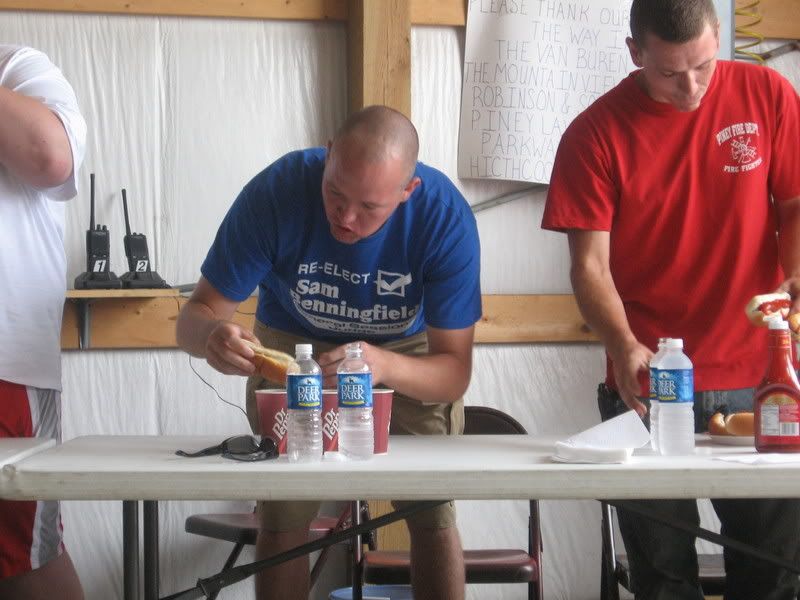
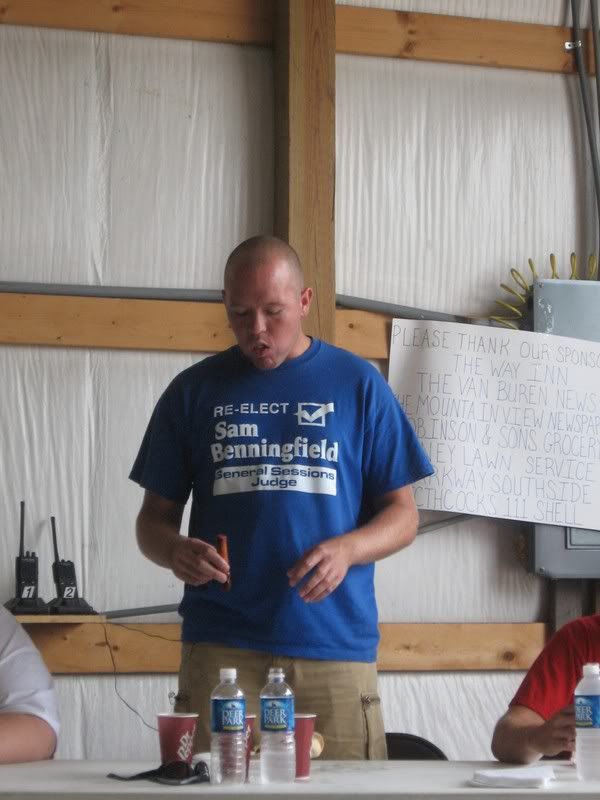
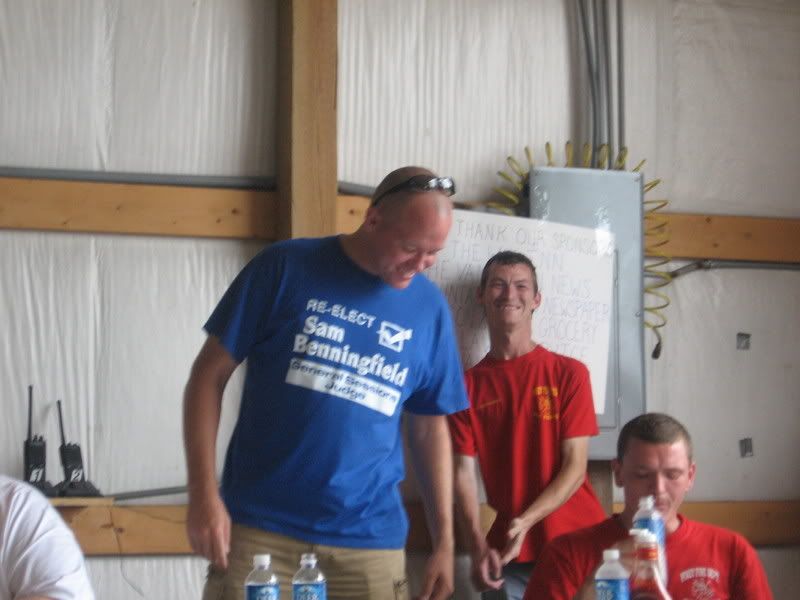
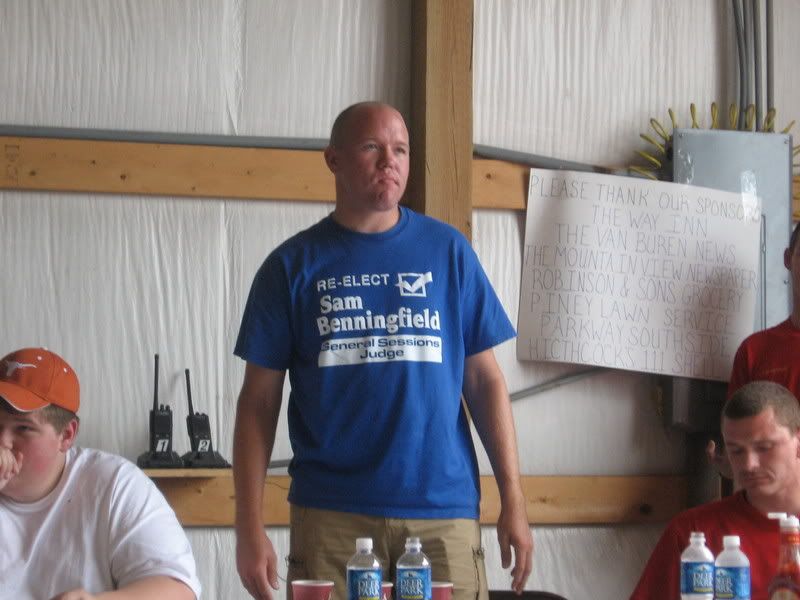
I had many responsibilites during that time, mostly revolving around signs with Sam's name on them, but when ever possible it was good to be seen by the public eye (ie. getting your picture in the paper with "Re-Elect Sam Benningfield" on your T-shirt).

So that is what these pictures are. They are some that were taken during a little public outing: a fire hall fund raiser. Now most wouldn't have thought of me as a hotdog eating machine, and compared to the ones on ESPN, I'm not, but some how I held my own that day.

The rules were simple: eat as many hotdogs as you can, bun and all, in ten minutes. Anyone who looked like they were about to give the dogs back were asked to stop eating and move away from the area. Anyone who let loose was disqualified.


Now there is more to eating hotdogs than most would think. I took some advice from friends who watched the epic battles on ESPN and learned very quicking two things. Take the bun and dog apart. Dip the bun in water and squeeze all of the air our for better results.

The time hand come and we were off. I didn't really know at I was doing. The larger guy to my right started off much faster that I did. I didn't know if I would keep up. But I stayed at it, swallowing dogs and dipping bread in water.

I lost count of how many I had eaten pretty soon, my stomach started to feel up, my throat felt like I still had food in it after swallowing, and because I was eating much slower the bread was getting very soggy and made me near sick many times.

But I kept eating, I would have to stand up and stretch out my stomach. Eventually, the limit had been met. I shoved down just a little more to finish the dog I was eating and the final talley was taken. I thought forsure the guy next to me had won, even though he sat down very early. Coming down the line they announced the scores. The guy next to me had only eaten eight and I knew that I had passes that.

It was down to only two people, and older woman and myself. I remember her talking before the contest of her winning ones before. She was an expert and this was my first attempt. I knew that she had won, I knew that I had failed. They gave her number, 10.5. I was suprized, I thought it would have been higher. They gave my number, 13. I had won, I couldn't believe it. My stomach was fun and I was happy.


So, they gave me my award, $50, which I of course gave right back to them and then I had my picture taken, with my "Re-elect Sam Benniningfield" t-shirt on. It was a sucessful day. I had accomplished the task. Now, the fulfullment of all of that came when we were in Coffee Corner and it was anounced that Sam had won. Not that my eating won it for him, but it is nice to think that I took part in something that affected so many and the "honorable" Sam Benningfield kept his seat.


Oh, such great memories. Thank you to all who made such a great time possible. It was a hard summer, but I would repeat it in a heart beat. Long days of driving around putting up signs, meeting people I didn't know, going door to door for hours so many nights, and going home with the family that loved me enough to provide a place for me to live. I'll never forget last summer

Friday, December 29, 2006

Encouraging the Saints

It is a joyful thing that God has given me when He allows me the opportunity to talk with a fellow saint in need of encouragement. It is a wonderful gift to have a fellow saint encourage me when it is I who is weak. I find that encouraging one another should be a supreme concern of the brethren. We as man are weak and in great need of grace, from both God and His church. Not that God is insufficient in the grace that He gives, but that He chooses to administer much of His grace through the church.

I love grace. One of my favorite theologians and authors is Augustine of Hippo. He either understood grace better than most men understand it, or just had an amazing style to articulate it. Augustine loved grace. He realized the depths of his wickedness and need of God’s grace. I try to emulate Augustine’s love of grace. Augustine also believed that one of the church’s faculties was to extend that grace to His church, from one believer to the other.

What is it to extend grace? Does it mean that we allow all things to go and forgive without rebuke? No. May it never be. The definition of grace I am using is a gift of love unmerited by the receiver. We are to love our one another. We are to place each other above ourselves and be willing to surrender all for good of others. Why, be because they have merited it? No. We do it because we have received grace. We receive the benefits of grace in our justification and sanctification. No only has Christ spared us from the wrath to come at judgment but He transforms us into His likeness until it is finished at our glorification.

There are times when encouragement must come from a rebuke. A rebuke should not be a stand of self-righteousness. It should not resemble the attitude that the one rebuking is better than the one rebuked. Both are fallen sinners redeemed by God’s mercy. A rebuke should be a correction of an act that does not bring glory to Christ and an encouragement to do something else that will. Encouraging does not always mean making the other feel better. Some times, it means pushing them toward righteousness; encouraging them in their sanctification and encouraging them in their relationship with Christ.

On a personal note, I am an extremely prideful person. I try to be humble, but I fail horribly. If our salvation was based on whether or not we could be “good” Christians, I would have given up long ago. Those who know me best know that I am prideful, arrogant, and boastful. Many in their hope to encourage me tell me of my good qualities, which I contend are simply outpourings of the grace bestowed upon me. In these times, I must flee or I grow in love with their flattering words. Yes, it is good to be complimented at times, but to a wretchedly prideful heart, it is like the quake of the earth that causes lava to rise to the surface. The pride of my flesh still richly persuades the indwelling sin of my old man.

Therefore, I am most encouraged when I am rebuked for my pride. One of my closest friends, Lance, who I hold very dear to my heart, is very quick to rebuke me. My pride I fear is most evident on the playing surface of any sport I participate. It is a sinful act for me to walk onto the football field or basketball court without a moment of sincere prayer asking my God and Savior to be with me that I might not sin against Him by the overrunning of my pride. History will go to tell that I still fall into sin and have been in need of serious rebuke on multiple occasions. Sadly, I have to not entertain myself with athletic competition to often to help with the ego that I have.

However, I love Lance because he is quick to encourage me. He come to me in love and says, “Naak, stop acting like that.” At times, he says other words; most of the time he does not have to. He could quote to me Scripture, but I know them. So what happens? I see what he is saying and I repent and become the most humble person on the field. No, that never happens. Usually, I get mad at him for calling my actions into question. I finish the game with an angry attitude and empty of any joy. I go home and think how I was right and they were wrong, especially Lance who dared to say anything to me about it.

Few people I know are willing to give me the grace Lance has given so many times. Lance was willing to come to me and rebuke me. He corrected me and encouraged me to act in a manner worthy of my calling. That is grace and that is love. What has resulted from that? I hope that I am a little better at holding in my pride while playing sports. I hope that I am less prideful in my day-to-day life, though I know I am still far too prideful. This I know for sure. One, I am able to spot my pride easier and correct it to some degree before some one has to say something to me about it. Two, I do not defile the name of God and diminish His glory as bad as before because I do not allow myself to go as far as I once did. Note that I did say, “as bad”, because I still sin and hurt the Name above all names.

How does the story end when Lance showed grace in rebuking me? I would eventually see that I was wrong. I have always been a little slow. I do finally repent and ask forgiveness from my Father. Prayerfully ask that He will help me get better at not being such a prideful man. I go to Lance and apologize for my actions. What I love is finding that I am forgiven. Just like asking for forgiveness from my Father, I do so knowing that I am forgiven. My sin has already been wiped away. It has been removed from my debt. The same is true with Lance. Not once have I gone to him and him act angry toward me. I would not blame him if he did, but he never does. He tells me not to worry about it. He knows I learned my lesson. He probably even knows it will happen again. Nevertheless, what does he do? He shows grace. And by grace I am encouraged. This I know for sure also, Lance’s and my friendship has grown stronger because of his willingness to rebuke me. Now, the friendship that we have is mutual. We both encourage each other the like manners. Because of that, we are very close friends and when we need to be encouraged in our weakness we feel that we can go to each other because we loved each other enough to show grace when we needed to rebuke one another.

The only man who might have better-articulated grace better than Augustine was the Apostle Paul. There was another man who loved grace. Paul who calls himself the chief of sinners knew what it was to need grace. He was dependent on grace. If Augustine or any of us know what grace is, it is because Paul told us. Just to demonstrate how much Paul loved grace he wished grace on all of those who received his letter: from the immoral Corinthians to the self-righteous Galatians.[1] In those letters, Paul heavily rebukes them for their sin. He tells the Corinthians that they are doing things that even sinners do not do.[2] He comes before the Galatians and tells them that he is amazed that they have so quickly deserted Him who called them by the grace of Christ[3] and then finds it necessary to defend his calling[4] and message[5]. Even among these breather who are defiling the name of Christ Paul extends to them grace.

What is Paul’s hope in the extension of grace? Notice what follows Paul’s extension of grace in every one of his greetings. Not only grace to you, grace and peace. Where God’s grace is, there is also peace. Peace is the product of God’s grace. Where peace is lacking God’s grace is not evident. We must do all things out of God’s grace in the hope that it will bring peace. This understanding attacks the very core of self-righteousness, which wants to stir up strife so that one is seen as greater than the other one. The self-righteous heart wants nothing to do with peace. It has no understanding of grace. Everything we do should be judged by this: is it done out of grace in order to bring peace? This does not mean that truth is abandoned to keep peace, because God is truth and grace is of God and therefore peace is only found in truth.

Therefore, “Brethren, even if anyone is caught in any trespass, you who are spiritual, restore such a one in a spirit of gentleness; each one looking to yourself, so that you too will not be tempted. Bear one another’s burdens, and thereby fulfill the law of Christ. For if anyone thinks he is something when he is nothing, he deceives himself. But, each one must examine his own work, and then he will have reason for boasting in regard to himself alone, and not in regard to another. For each one will bear his own load.”[6]

[1] Romans 1:7; 1 Corinthians 1:3; 2 Corinthians 1:2; Galatians 1:3; Ephesians 1:2; Philippians 1:2; Colossians 1:2; 1 Thessalonians 1:1, 2 Thessalonians 1:2; 1 Timothy 1:2, 2 Timothy 1:2, Titus 1:4
[2] 1 Corinthians 5:1
[3] Galatians 1:6
[4] Galatians 1:11-24
[5] Galatians 2:1-6:16
[6] Galatians 6:1-5